
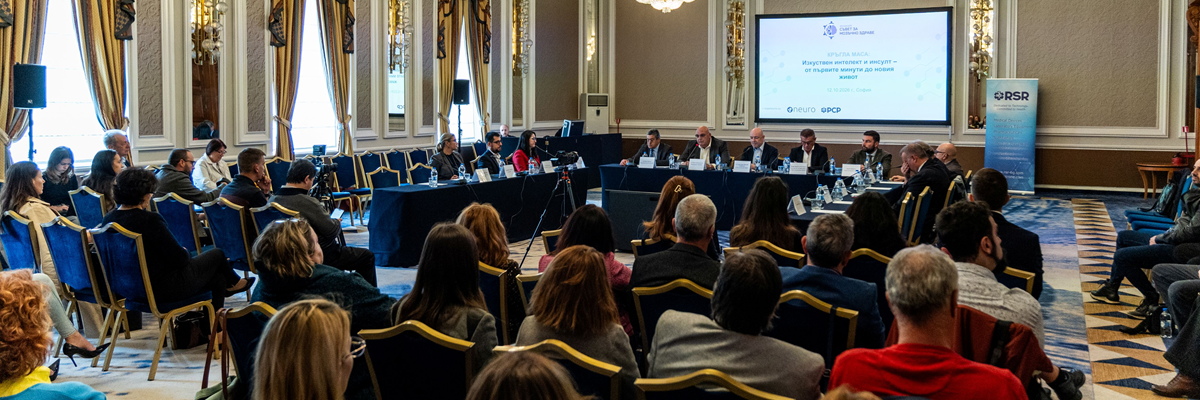
Dr. Boryana Alexieva, AmCham Bulgaria Member of the Board of Directors and Healthcare Committee Co-Chair, joined the discussion on how artificial intelligence and digital technologies can support faster diagnosis, timely treatment and personalised recovery
Sofia, 12 October 2026 – AmCham Bulgaria took part in the roundtable “Artificial Intelligence and Stroke – From the First Minutes to a New Life”, organised by the Foundation Council for Brain Health ahead of World Stroke Day on 29 October. The forum was the first meeting of the Foundation’s initiative “The Brain – Our Future”, which promotes dialogue on brain health among the medical community, institutions and society.
AmCham was represented by Dr. Boryana Alexieva, Member of the Board of Directors and Co-Chair of the Healthcare Committee. She welcomed the work of Prof. Nikolay Gabrovski and the Foundation, saying that such initiatives bring greater attention to brain health and encourage collaboration across disciplines and sectors.
Health as an Investment

Dr. Alexieva presented the Chamber’s view that health is an investment in human capital, economic resilience and long-term development, not only a public expense. She pointed to AmCham’s Healthcare White Paper, its engagement with the Government and its proposal to the Council of Ministers for a Strategic Council on Healthcare. The Council would provide a platform for sustained, forward-looking dialogue on prevention, financing, access to innovation, workforce, digital transformation and measurable outcomes.
Three Principles for Innovation
On the use of AI and other advanced technologies in healthcare, Dr. Alexieva outlined three principles:
- Brain health is an investment in human capital. Recovery determines whether people return to work, regain independence and stay active in their families and communities.
- Innovation matters only when it reaches the patient. The real test is whether it can be implemented responsibly, equitably and sustainably in everyday healthcare.
- Technological progress must be linked to measurable outcomes, such as shorter time to diagnosis and treatment, better functional recovery, wider access to rehabilitation and improved quality of life.
“Technology should support clinical expertise, not obscure professional responsibility,” she said, adding that technology does not by itself repair weaknesses in a system.
A Partnership Offer
AmCham declared its readiness to be a partner of the Foundation Council for Brain Health. Dr. Alexieva proposed involving experts from three AmCham committees in the discussion: Healthcare, Digital Economy (AI, data and cybersecurity), and Human Capital and Education (skills, workforce and productivity). The format and areas of contribution would be developed jointly, in line with the Foundation’s priorities.
“Business should not replace public institutions, medical professionals or scientific expertise. Its contribution is to bring knowledge, innovation, implementation experience and the ability to build partnerships across sectors,” she said.
She concluded that the most important resource to protect is not a technology or a system, but human potential.
About the Roundtable
The event, moderated by Prof. Nikolay Gabrovski, Chair of the Foundation and Head of the Neurosurgery Clinic at Pirogov University Hospital, presented iStroke-BG, a Bulgarian online calculator for assessing the 5-year risk of ischemic stroke, available at bezinsult.bg. Leading neurologists, neurosurgeons and a health economist also discussed how AI can shorten the time to treatment, connect regional hospitals through a digital network, support personalised rehabilitation and reduce the economic and social burden of stroke. Representatives of the Bulgarian Medical Association, professional and business organisations, medical specialists, experts and media also took part.
The experts agreed on the need for continuous care covering prevention, timely treatment and recovery, with new technologies supporting each stage.ehabilitation. In this way, they can help reduce the burden on the healthcare system, families and society, and bring more people back to a fulfilling life.