
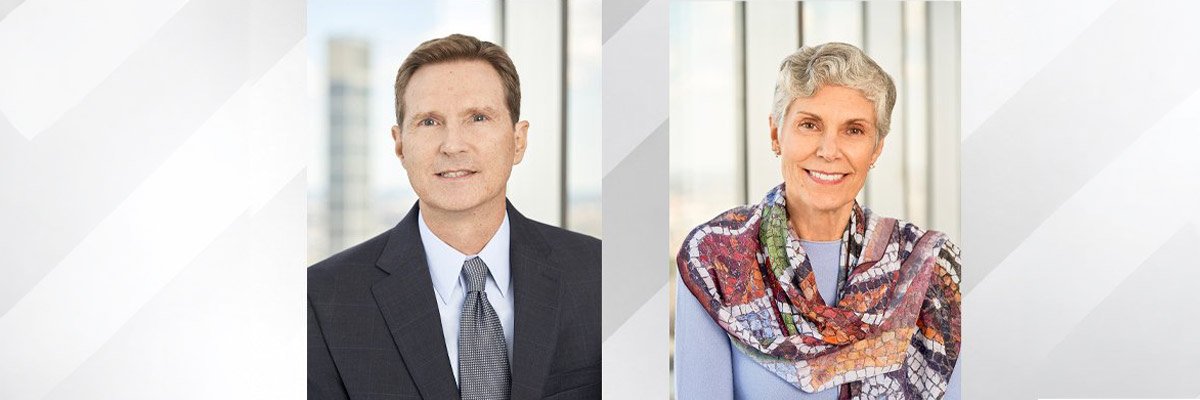
As Ambassador Rod Moore takes the helm of the America for Bulgaria Foundation (ABF) as its new president and CEO, and Nancy Schiller is concluding her tenure after a decade of leadership, they reflect on the people, experiences, and unexpected discoveries that shaped their connection to Bulgaria – and what lies ahead.
ABF: At this stage of your life, what has to be true of an opportunity for you to say, “Yes, I’m willing to uproot my life for this”?
Rod Moore: First of all, and most importantly, I think everyone has to have a purpose. When you get out of bed in the morning, what is it that I want to be working towards or achieving?
When the prospect of applying for this job as president of the America for Bulgaria Foundation came up, I thought to myself: it really brings together a lot of things that really motivate me. One is my great and abiding affection for this country, where I’ve spent a lot of time. I’ve lived in Bulgaria for six years in total, over three different assignments with the US government. Another is the opportunity to work with some pretty great people that I like and admire and respect, both inside the organization and outside.
ABF: You have described coming back to Bulgaria as a homecoming. What is it about Bulgaria and Bulgarians that has kept drawing you back?
RM: There’s no place in the world I’ve spent more time living outside of the United States than Bulgaria. And over time, I developed this great love for this country. But there’s something more than that in my mind. I feel, because of fate, I first landed here professionally at the beginning of the changes in Bulgaria, and even though I was an outside observer – а guest and а witness – I still feel like I’ve been experiencing this transition alongside a generation of Bulgarians, many of whom I still see.
ABF: Your relationship with Bulgaria, however, began almost by accident. Tell us more about this.
RM: One day my older brother, who never ever gave me any advice whatsoever – we were sitting in front of our house, in our driveway – he says, “Rod, I’ve been thinking. You really like languages. There’s this Cold War going on. We’re in this adversarial relationship with the Soviet Union. Why don’t you study Russian? Learn a little bit more about it.”
I was so enamored of the education in my Russian studies degree, I thought I’d like to learn more about this part of the world, and I learned I could do a master’s degree in Slavic linguistics, but to do so, I had to take two additional Slavic languages.
Well, again fate intervened: there were only two Slavic languages being taught at my university at that time, Czech and Bulgarian. I signed up for Bulgarian – I was the only student in the class – but I thought it was pretty cool because it was so unique. Then one thing led to another, and here I am talking to you.
ABF: You have now encountered Bulgaria at very different moments. What’s different today that the young diplomat who arrived here decades ago would find hardest to believe?
RM: During my first tour here, we had electricity rationing. Frequently we would have to travel to Greece to buy green vegetables and so forth. There were very few cars on the streets, and the ones here tended to be Trabants and Ladas, a few Volgas here and there.
Obviously, this country has changed enormously economically. The GDP has expanded enormously, and the living standard has improved tremendously. I would say, in that area, the vibrancy, breadth, and variety of the economy is something I never could have believed or imagined arriving as a young diplomat in 1990.
Also, as I’ve said to other people, when I first got here, Bulgaria was still under the Bulgarian Communist Party, at least for the first couple of months of my time here. There had been no democratic multi-party elections, at least in many decades. The country was still a member of the Warsaw Pact and the Comecon.
I remember, at the time, a young member of parliament named Solomon Passy – I read it in a newspaper – was asking about NATO membership. I asked my boss, “Should I go meet this guy?” I went over and met with him, and of course he asked what would happen if Bulgaria applied to join NATO. I said, “I don’t know. Bulgaria is still a member of the Warsaw Pact.” So we sent a telegram back to Washington, and we got this terse answer back: “NATO enlargement is not on the agenda.” But zoom ahead: it was only 13 years later, 14 years later, that Bulgaria became a full-fledged member of NATO. Three years after that, a member of the European Union. So much has transpired.
ABF: Going from diplomacy to leading a private foundation looks like a major career change. Does it feel that way to you?
RM: Yes, it does. I’ve never run a foundation before. So why am I possibly qualified to do this job? It’s a great question. I ask myself that every day.
I would say that, in the diplomatic service, every three years we go to a new job, and frequently we know very little about the job we’re going into. It’s baptism by fire. So that gives me some comfort that I’ve learned how to adapt and to adjust.
Also, during my last job before this one, I was also wholly unqualified to hold that job. I was director of a master’s program, an academic program in international affairs. I had never done that before.
And in those previous jobs and in that job, what I learned is: don’t come in thinking that you know it all. Listen, admit when you don’t know what you’re doing or how to do something, and trust your staff, listen to your staff, and then just figure things out, and don’t be afraid to make mistakes. And if you make a mistake, own up to it and try not to repeat it. So I hope that the same pattern will apply here.
ABF: You have inherited an organization that isn’t looking for someone to invent it from scratch. What do you think the Foundation already does well, and where do you think you can add something?
RM: Our vision for Bulgaria is something I think everyone should be able to get around: “Bulgaria’s dynamic economy and its thriving democracy ensure fair and ample opportunities for all its people to flourish.” I mean, who could possibly argue against that? It’s such a wonderful, forward-looking vision.
I can provide a new perspective, or a different perspective. I think it’s healthy in any organization to have new perspectives come in. It’s one of the reasons I have such great respect for Nancy Schiller, who, of her own accord, decided, “Well, I’ve been doing this job for a long time. Maybe it’s time, at a high point, to move on and do other things.”
You know, it’s very humbling and daunting to follow Nancy Schiller because she is such an amazing woman who has accomplished so much. I have enormous admiration and respect for her. So I don’t expect to replace Nancy Schiller; I’m succeeding Nancy Schiller.
Some of the things that I’ve seen her do, which I respect and admire the most: her ability to build relationships, to be visionary, to bring people together, and to solve problems. She’s a consummate problem solver, and I think those are just incredible qualities that she has. I’d like to be able to try to emulate some of those in my own work here.
Nancy Schiller: I Am Proud of the Community We Have Developed
ABF: Ten years ago, you said in an interview that “the Foundation should measure its grantees’ success in the small steps achieved, as every step forward is a step in the right direction.” Which of those small steps turned out to be not so small?
NS: One of the things that I’ve always said to my colleagues is that we have to celebrate every victory, no matter how small it is, because sometimes victories are long in coming. It takes a long time sometimes to be effective, to find the right formula.
But one of the things that I would say I’m most proud of is the community that we’ve developed, the outreach that we as a foundation have done to not just civil society organizations or volunteers, but businesspeople, the diplomatic community, the political class, elected officials, to try to bring together the sense of community that together we can have impact, that we can make a difference. And to see the community that’s developed over all these years, and the sense of belonging, the sense of wanting to do something to make Bulgaria an even better place to live, is what I’m most proud of and where I find this foundation has made a significant contribution.
ABF: You have spent years trying to bring businesses into conversations about issues that affect all Bulgarians, but are too often left to civil society to resolve. Why has that mattered so much to you?
NS: Change, effective change, has to be all of society. You need engagement from all sectors of society.
Businesses are in business to make money, clearly. They’re not in business to stick their heads too far up above the ground and risk affecting their business. However, policy affects business. It doesn’t just affect civil society. So when a government policy might restrict the role of civil society organizations, businesses need to speak up because it ultimately will affect, whether it’s recruitment of employees, whether it’s the ability to do the types of training they want to do, they need to have a voice. They have a powerful voice. And when they unite, whether as a business association or as a group of interested parties, and join with civil society organizations, it is an amplifier.
It’s wonderful to see businesses that have been successful – some of your unicorns, some successful businesspeople – forming their own foundations and doing similar work to improve society in Bulgaria.
ABF: What is something about philanthropy that you understand very differently today than you did 20 years ago?
NS: Philanthropy has to be relearned in society. I know that it existed in the late 1800s, early 1900s. Some of your amazing universities, hospitals, and chitalishtes were founded by generous donors, but you had 50 years where that no longer existed.
Relearning that history is important. Civil society organizations need to learn that asking for support is not begging. And we all need to be reminded every day that what civil society organizations do is really important to society.
And encouraging them to value their own work so they can go to a potential donor and say, “This is important for you as well.” It’s a really hard thing to learn, to absorb, to recognize that what you do as a nongovernmental organization has value to society.
And being brave enough to hear a “no” and then go knock on the next door, because what you do has value.
ABF: What are you proudest of in the work of the Foundation?
NS: One thing that I’m particularly proud of is what we did with Pirogov Children’s Wards. This was almost nine years ago. A little conversation that I had with a staff member turned into something transformational for children throughout this country.
We went and looked at Pirogov and saw the condition these wards were in, and I knew they could be so much better. Having the trust of the donors who came on board, the trust of the medical community at Pirogov, the trust of the government, which agreed to do the renovation while we did the rejuvenation, and the donations we received… People came forward because they knew it was important.
What started as a 100-square-meter project that was just supposed to be the reception area turned into 65 rooms, three floors of children’s wards being completely refurbished.
And to me, that is the power of community, the power of philanthropy, and the power of having a vision for something better.
ABF: For the last 10 years, Bulgaria hasn’t simply been where you worked; it’s been home. What is hardest about leaving?
NS: It’s always the people. My colleagues at ABF are amazing people. Now, it’s not goodbye, just farewell for now, because I’ll be back as a director [member of the Board of Directors] after a year.
But it’s the people who share a love of this country and a desire to make a difference, and the opportunity to get to know them. That’s what I’m going to miss. And the ability, because of what this foundation does, to effect change. To look at something and say, “We can help here.” That’s really powerful, whether it’s a small project or something grand like the Basilica or the Ivan Vazov House Museum.
It’s seeing something, finding a partner who shares your passion and commitment, and saying, “We can do this.” And then making it happen. I’m going to miss that.
ABF: What are you looking forward to getting back in your life? Particularly after so many years away from family and old friends.
NS: I mentioned already I’m a two-times baba. I have a new grandson, a little over a month old. The ability to see my family a little bit more, not being 10 time zones away from a conversation – that will be a good thing. My family’s come here a number of times to visit, and I go back to the US to visit, but it’s not the same. I’ve missed a lot.
I don’t regret it because I know what we do here is important, what I do here is important. I look forward to one day bringing my grandchildren and showing them what we’ve been doing together.
ABF: What is it like to hand responsibility for this next chapter to someone else?
NS: I am beyond thrilled that Rod Moore has taken this position, that he was selected. He’s going to be extraordinary. Any hesitation I have about my decision to retire [is now gone]. With no hesitation whatsoever, this foundation is going to be in such strong hands. I couldn’t be happier that Rod agreed to take this on.
His love of this country, his knowledge of it, and his three postings here over the course of his diplomatic career make it easy for him to jump right in.
ABF: After 35 years of watching this country change, 25 years from both inside and outside, and the last 10 while living here, what still makes you optimistic about Bulgaria?
NS: The people, the people, absolutely.
Some of the optimism that I’ve brought here – I like to think it’s a little bit contagious. And that people believe that they can do what they set out to do. That they will have friends supporting them. A community around them.
THE FULL INTERVIEWS you can read/watch here: